Opens in a new tab

Melanoma Specialist in Seville

Over the last 25 years, Dr. Moreno has led the introduction of innovations in the treatment of advanced melanoma.
Today, melanoma requires a specialised, multidisciplinary and individual approach.
Accurate assessment of the tumour, surgical planning and the integration of systemic treatments when indicated are essential to offer each patient the most appropriate strategy.
UNDERSTANDING THE DIAGNOSIS

What is melanoma?

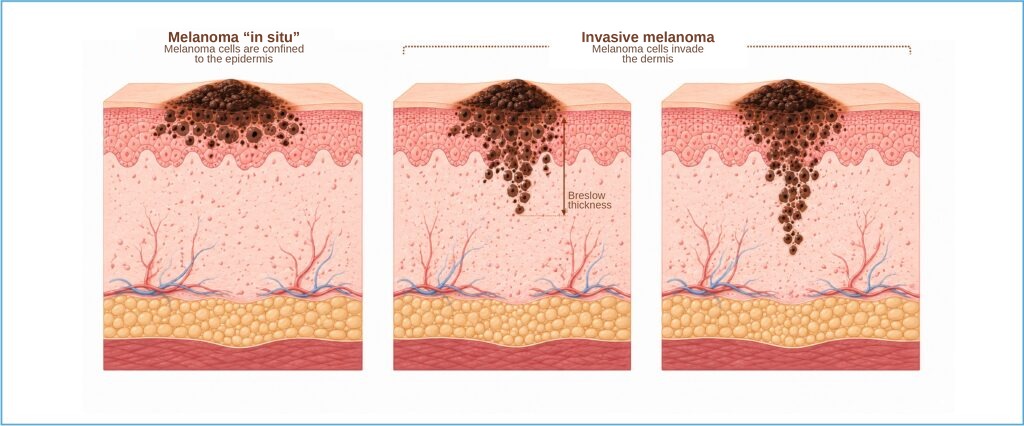
Melanoma is a malignant tumour that arises from melanocytes, the cells that produce the skin's pigment. Although it is less common than other skin cancers, it is more likely to spread and accounts for a significant proportion of deaths from skin cancer.
Its incidence has risen significantly over recent decades. In Spain, more than 8,000 new cases are now diagnosed every year. The prognosis depends mainly on the stage at diagnosis and on tumour characteristics such as Breslow thickness, ulceration and possible spread to the lymph nodes or distant sites.
When it is diagnosed at an early stage, surgery remains the main treatment and cure rates are very high. In recent years, the introduction of immunotherapy and targeted therapies has also transformed the treatment and prognosis of patients with higher-risk melanoma or advanced disease.
PROCESS

How is melanoma diagnosed?

01

Clinical appearance

Melanoma has the advantage of being visible to the eye. A pigmented lesion that changes in colour, size or shape should raise the suspicion of melanoma.
02

Dermoscopy

With the help of a magnifying device, the dermatoscope, the dermatologist can identify features that lead to the diagnosis of a possible melanoma.
03

Pathology

Finally, any lesion suspected of being melanoma will be removed and examined under the microscope to confirm the diagnosis and determine the Breslow thickness.
TREATMENT APPROACH

How is melanoma treated?

Surgery for the primary tumour

The treatment of melanoma consists of an excisional biopsy, which removes the primary tumour, confirms the diagnosis and determines the Breslow thickness.
If the excisional biopsy confirms a melanoma in situ or a melanoma with a low Breslow thickness, this treatment may be curative.
Once the diagnosis of melanoma has been confirmed, current guidelines recommend a wider excision of the margins around the scar, depending on the Breslow thickness.

Sentinel lymph node biopsy (SLNB)

SLNB is a surgical procedure that makes it possible to detect whether the melanoma has spread to the lymph nodes.
Whether SLNB is recommended depends on the Breslow thickness.
In some cases, the result of the SLNB will help with decisions about the need for further treatment (adjuvant immunotherapy).
SLNB also provides important prognostic information.

Surgery for lymph node disease

When melanoma produces lymph node metastases, surgery may include removing the lymph nodes in the affected region through a therapeutic lymph node dissection.
The indication for and extent of surgery must be decided individually according to the location, the volume of disease and the characteristics of each patient, especially in the current context of neoadjuvant and adjuvant treatments.
PRACTICAL INFORMATION

Frequently asked questions about melanoma

It is the measurement, in millimetres, of how deep the melanoma reaches into the skin. It is one of the main factors in determining the stage, the prognosis and the surgery required.

The lower the Breslow thickness, the better the prognosis and the chances of curing the melanoma.

The margin depends mainly on the Breslow thickness and the location of the melanoma. In general, it ranges from 0.5 cm for melanoma in situ to 1–2 cm for invasive melanoma, depending on the depth reached.

SLNB can detect microscopic metastases that are not visible on examination or on imaging tests.

It is therefore recommended for melanomas with a higher risk of lymph node involvement, determined mainly by the Breslow thickness and other features of the tumour.

In general, SLNB is considered when the Breslow thickness is greater than 1 mm and in other high-risk situations (ulcerated tumour, etc.).

A positive sentinel lymph node means that melanoma cells are present in the regional lymph nodes. If the SLNB is positive, starting adjuvant immunotherapy may be considered.

Not all melanomas require imaging tests. Whether they are indicated depends on the Breslow thickness, lymph node involvement and other risk factors. When indicated, they may include lymph node ultrasound, computed tomography (CT), PET-CT or magnetic resonance imaging (MRI), to assess whether the disease has spread and to plan the most appropriate treatment.

Adjuvant immunotherapy involves giving medicines that stimulate the patient’s immune system once the tumour has been completely removed. Its aim is to reduce the likelihood of the melanoma coming back.

Neoadjuvant immunotherapy involves giving these medicines before surgery for the metastasis. Its aim is to shrink the metastasis to allow more conservative surgery and to reduce the likelihood of the melanoma coming back.

Specialist consultation

Dermatologist · Dr. David Moreno
Request an Assessment